

A standard, off-the-shelf sphere is designed for a common bore, a common seat arrangement, and a general-purpose set of conditions. Many industrial valves cannot live with that compromise. When the port must be characterized, the alloy must match a corrosive medium, the seating must be metal-to-metal, or the pressure and temperature sit at the top of the range, performance is limited by the ball as much as by the body or the actuator.
A Customized Ball Valve Ball improves performance when it is designed as a system: geometry, material, dimensional control, and surface treatment selected together for the duty. The result is a tighter shutoff, a more stable running torque, a longer seat life, and, where a V-segment or other special port is used, a flow characteristic the standard round port cannot provide. This article explains those gains, and how they differ from buying a stock ball and hoping the valve will adjust.

Catalog spheres work well in many water, utility, and general process valves. They become the weak point when the bore or port shape is non-standard; the valve is a three-way or otherwise special configuration; the ball and stem must be integral; the duty is high temperature, high pressure, or corrosive; the seats are metal faced; or the leakage and cycle-life targets are tighter than a commercial sphere can support.
In those cases, the valve assembler is forced to adapt the seat, the stem, or the acceptance test to a ball that was never designed for that valve, and performance then depends on shop-floor adjustment. A custom ball reverses that relationship: the sphere is produced to the valve’s drawing, in a pressure-class range commonly from 150LB to 2500LB, so the valve can be assembled and tested to its design intent.
The comparison is not “custom versus cheap,” but “a ball specified as part of the valve” versus “a ball selected from a generic size list.”
Shutoff quality depends on a uniform contact band between the ball and the seats. A custom ball contributes to that band in three ways. First, spherical diameter and sphericity can be held to a tight envelope—dimensional tolerances controlled within ±0.01 mm are a typical precision requirement—so the seats are loaded evenly. Second, the surface can be finished, and if needed hard-faced or coated, for the actual seat material, whether PTFE, reinforced PTFE / PPL, or a metal seat with hard facing. Third, the port edges, stem slot, and, on trunnion designs, the support features can be located so the ball does not tilt off-center when the valve is closed.
A standard sphere may be close to the required diameter and still leave a leakage path if its sphericity, finish, or stem-feature location is only commercial. That leakage shows up as a failed seat test, as a need to over-tighten the seats (which raises torque), or as a valve that passes the test once and then leaks after a short period of cycling.
For floating valves, the ball must be free to shift downstream onto the seat in a controlled way. For trunnion-mounted valves, the ball must stay centered under pressure while the seats load the sphere. A custom ball can be machined for either support method. Using a floating-style blank in a trunnion valve, or the reverse, is a design error, not a sourcing convenience, and it will show up as leakage or as excessive stem load.
Industrial valves in oil and gas, chemical, power, and water-treatment plants are often judged less by the first leak test than by how they behave after repeated operation. Seat wear, coating breakdown, and rising torque are the usual long-term failure modes, and all of them are influenced by the ball.
A custom ball improves cycle life when the alloy matches the medium, the surface treatment matches the wear mechanism, and the machined geometry prevents local overload of the seat. An A105 or LF2 ball with a suitable coating may be correct in general or low-temperature hydrocarbon service; F304, F316, F321, or a 13Cr grade may be required in wet or mildly corrosive service; duplex or nickel alloys may be required when chlorides or severe chemistry dominate. Pair that substrate with ENP, TCC, CCC, Stellite, nitriding, hard chromium, or a NI60/NI55 overlay only when the duty needs it, so the seat is not the first part to be destroyed.
Stable torque is part of the same story. High spots, rough finish, incompatible hardness against a metal seat, or a stem interface that cocks the ball all increase breakaway torque and make actuator sizing unreliable. A ball produced to a defined tolerance and finish gives the valve manufacturer a repeatable torque band, which is a performance requirement, not only an assembly convenience.
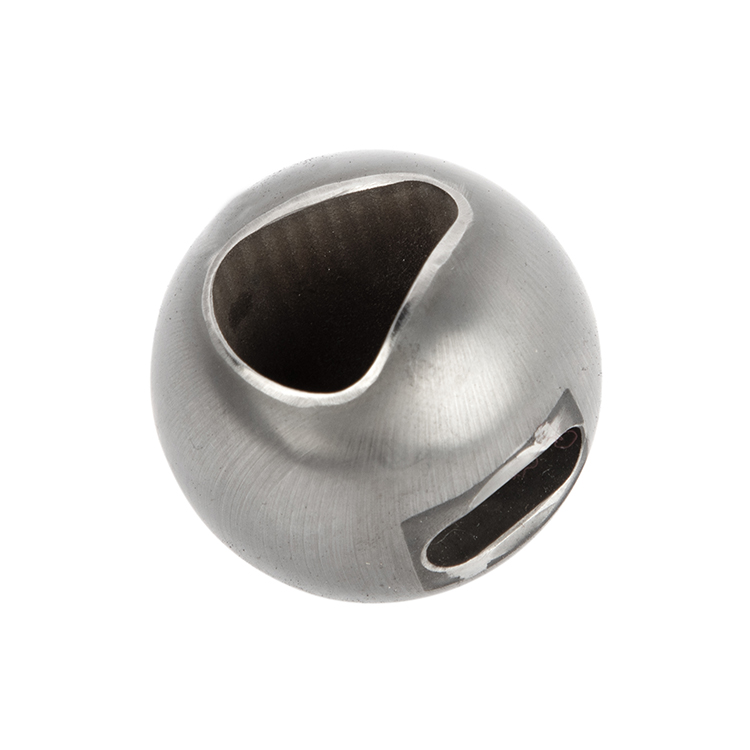
Not every performance problem is a leak. Many process valves must regulate flow, not only open and close. A V-segment or V-port custom ball gives the valve a characterized opening, such as a more gradual change of flow with rotation, that a standard full-round port cannot provide. That is a performance improvement in control applications in chemical, power, and other process plants: more usable range, more predictable flow behavior, and less of the sudden flow step that a ball valve is often criticized for.
The gain only appears if the V-profile, its angular relationship to the stem, and the edge finish are machined as specified. A poorly cut “V” is not a control valve; it is a damaged port. The same logic applies to three-way balls, where the intersection of ports defines diversion or mixing performance, and to reduced or special bores, hollow balls, and plate balls that exist because the valve’s flow path is not a standard through-bore.
If the performance target is a flow curve, the drawing must include the port geometry, not only a sphere diameter.
The phrase that matters is “as a system.” Geometry without the right alloy will corrode or lose hardness. The right alloy with a loose sphere will leak. A correct sphere with the wrong coating will wear the seat or pit in the medium. A well-coated ball with an incompatible seat will still fail the leakage test. Performance improves when these choices are made together, for a defined duty, and then verified.
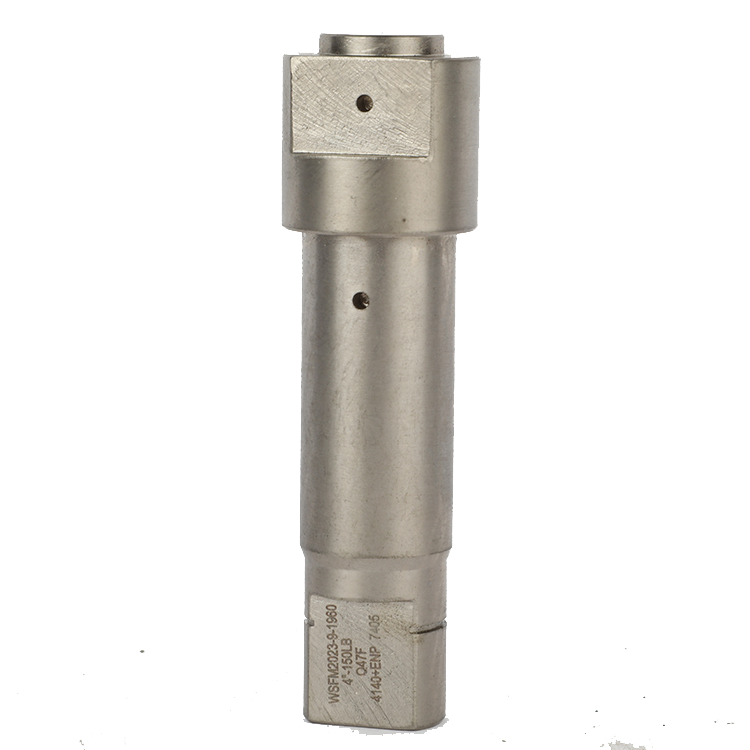
That system view also includes the rest of the trim. An integral valve-ball-with-stem can improve alignment and reduce a loose interface that would otherwise add hysteresis or side load. A separate stem is still a valid design, but then the slot or connection on the ball must be machined as a precision interface. If the seat is metal faced, the ball and seat should be specified, and ideally produced, as a matched pair; if the seat is a polymer, the ball finish and edge condition should be specified for that polymer.
Pressure class, temperature, and medium remain the boundary conditions. Custom balls can be produced for high-temperature, high-pressure, and corrosive media, and across Class 150 to Class 2500, but those ratings are achieved by the combination of design, material, machining, and surface treatment—not by labeling a stock sphere “severe service.”
Reliability, in this context, means the valve continues to seal and operate through the duty it was sold for. In oil and gas, that may mean a high-pressure trunnion ball, a declared sour or chloride-bearing medium, and a coating that survives the solids or the seat load. In chemical plants, it may mean a nickel-alloy or duplex ball with a port shape and finish suited to a hazardous medium. In power service, temperature and hard-facing compatibility often dominate; in water treatment, corrosion resistance and a clean finish against soft seats are often the priority.
A custom ball improves reliability in these industries when the manufacturer is given the duty and the valve design, not only a nominal size. It does not help if the custom request is only a looser restatement of a catalog sphere. The benefit comes from matching the part to the valve and the process, then inspecting the finished sphere—including tolerance, sphericity, and any coating—before the valve is assembled.
A Customized Ball Valve Ball improves industrial valve performance when geometry, material, tolerance, and surface treatment are specified as one system. Compared with a standard off-the-shelf sphere, that system can deliver a more reliable seal, more stable torque, longer seat life, and, with V-segment or other special ports, flow control that a round stock bore cannot offer.
The gain is earned on the drawing and at inspection, not by the word “custom” alone. For OEM balls produced to international standards, in classes from 150LB to 2500LB, share the valve design and duty data with a manufacturer that builds these parts as a core product, such as the customized ball valve balls available from GOTEB, and approve the first article against the leakage, torque, and geometry targets you actually need.
They are made to the valve’s geometry, alloy, tolerance, and surface requirements, so the sphere and seats can form a consistent seal, run at a predictable torque, and last longer in the actual medium. Special ports, such as V-segment designs, also improve flow control.
No. If the valve uses a common bore, a general-purpose alloy, and a commercial leakage class, a standard sphere may be sufficient. Customization improves performance when the duty or the geometry is beyond what a stock ball can support.
The V-shaped port characterizes the flow as the ball rotates, giving a more gradual and predictable control response than a standard round port. The profile and its alignment with the stem must be machined accurately for that benefit to appear.
Yes. A custom ball can be produced for either design. The support method must be stated on the order, because floating and trunnion balls are loaded and sealed differently, and a mismatch will hurt leakage and torque.
The port and stem geometry, material grade, seat type, surface treatment if required, and finished tolerances (including a tight envelope such as ±0.01 mm where needed), plus inspection against those requirements. “Custom” without those details is only a commercial label.


 Optimized by Seraphinite Accelerator